
Introduction
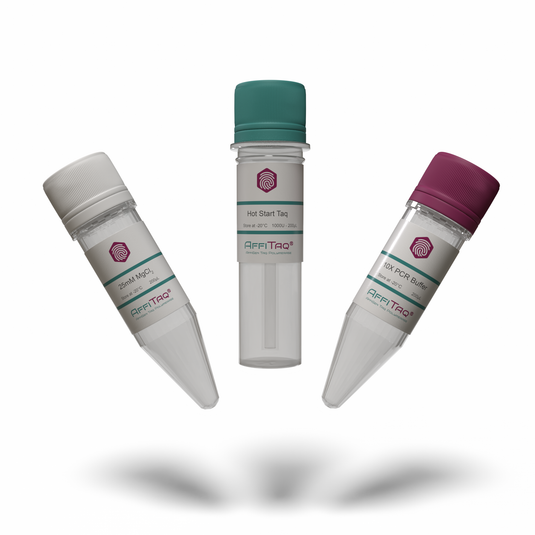
Hot Start DNA Polymerase (with Buffer, with MgCl₂, without dNTP) is a specialized PCR formulation designed to improve amplification specificity, reduce nonspecific background, and enable robust amplification from complex templates. This reagent configuration is widely used in qPCR, endpoint PCR, high-fidelity amplification, genotyping, sequencing library preparation, and low-copy detection assays.
The formulation consists of:
-
A Hot Start enzyme (chemically or antibody-inactivated)
-
A ready-to-use reaction buffer
-
MgCl₂ supplied at an optimized concentration (commonly 1.5–3.0 mM)
-
No dNTPs included, giving the user flexibility over nucleotide concentration and purity
This article provides a complete technical overview of molecular mechanisms, assay optimization, reaction chemistry, enzyme activation, and the practical implications of providing buffer + MgCl₂ but excluding dNTPs.
What Is Hot Start DNA Polymerase?
Hot Start polymerases are thermally activated DNA polymerases engineered to remain inactive at room temperature. This prevents:
-
Nonspecific primer binding
-
Primer-dimer formation
-
Low-temperature polymerase activity
-
Background amplification before denaturation
Hot Start systems use:
1. Antibody-mediated inhibition
An antibody blocks polymerase activity until heat denaturation (approx. 95 °C).
2. Chemical modification
Polymerase is chemically blocked and reactivated by heat.
3. Aptamer-based inhibition
A nucleic acid aptamer binds the active site until high-temperature activation.
4. Proprietary reversible inhibitors
Often used in commercial PCR master mixes.
The enzyme becomes active only after initial denaturation, improving specificity and sensitivity.
Why Include Buffer and MgCl₂, but Exclude dNTPs?
This configuration is preferred in advanced PCR workflows.
Advantages of Buffer + MgCl₂ Included
-
Ensures reproducibility between reactions
-
Maintains optimized ionic strength
-
Supports consistent pH and enzyme activity
-
Eliminates pipetting variability
Advantages of Excluding dNTPs
Allows full experimental control:
-
User can adjust dNTP concentration for low-copy templates
-
Enables incorporation of specialized dNTP analogs (e.g., dUTP, fluorescent dNTPs)
-
Supports qPCR, mutagenesis, or NGS library preparation protocols requiring custom dNTP ratios
-
Enables compatibility with UNG digestion systems (dUTP incorporation)
Not including dNTPs increases flexibility for:
-
Multiplex PCR
-
Long-range PCR
-
GC-rich or AT-rich genomes
-
High-fidelity proofreading enzymes
Reaction Buffer Composition
A standard hot start buffer typically contains:
-
Tris-HCl (pH 8.3–8.8)
-
KCl or ammonium sulfate
-
MgCl₂ (bound or free)
-
Stabilizers for thermal protection
-
Non-ionic detergents (Tween-20, NP-40)
-
Reducing agents (DTT)
-
Enzyme stabilizing proteins
The buffer ensures enzyme stability at denaturation temperatures and consistency across replicates.
Role of MgCl₂ in Hot Start PCR
Mg²⁺ is an essential cofactor for DNA polymerases.
Functions:
-
Stabilizes dNTP binding
-
Coordinates the active site geometry
-
Enhances polymerase processivity
-
Influences Tm and primer annealing behavior
Effects of Mg²⁺ concentration:
| MgCl₂ (mM) | Effect |
|---|---|
| Low (<1.5 mM) | Weak yield, low efficiency |
| Optimal (1.5–3.0 mM) | High yield, specific amplification |
| High (>4.0 mM) | Non-specific amplification, mispriming |
Providing MgCl₂ pre-optimized ensures consistent reaction performance.
Why dNTPs Are Not Included
This design provides maximum flexibility for:
1. High-fidelity or proofreading polymerases
Some require modified dNTP concentrations.
2. qPCR workflows with fluorescent probes
Probe degradation can occur with excessive dNTP concentrations.
3. NGS and mutagenesis workflows
Precise dNTP stoichiometry is crucial.
4. Use of modified nucleotides
Examples:
-
dUTP
-
Cy5-dCTP
-
Locked nucleic acid (LNA) mixes
-
7-deaza-GTP for GC-rich templates
5. UV-crosslinking contamination control systems
UNg (uracil-N-glycosylase) requires dUTP incorporation, which must be user-defined.
Mechanism of Activation (Hot Start Release)
Activation occurs during the initial denaturation step, typically:
-
95 °C
-
2–10 minutes (depending on inhibitor type)
Activation steps:
-
Temperature elevation disrupts inhibitor-polymerase interaction
-
Polymerase undergoes conformational shift
-
Active catalytic site becomes accessible
-
Amplification begins during annealing/extension cycles
This prevents premature polymerase activity, increasing amplification fidelity.
Performance Characteristics
1. High Specificity
No polymerase activity at ≤25 °C.
2. High Sensitivity
Detects low-copy targets with minimal background.
3. Consistent Amplification
Buffer and MgCl₂ ensure run-to-run consistency.
4. Improved Reproducibility
Ideal for clinical workflows, forensic DNA, and environmental low-biomass samples.
5. Wide Template Compatibility
Works with:
-
Genomic DNA
-
Plasmids
-
Viral DNA
-
Bacterial DNA
-
cDNA
Applications
Clinical Research
-
Detection of pathogen DNA
-
High-specificity diagnostics
-
SNP genotyping
-
Copy-number variation (CNV) analysis
Molecular Biology
-
Cloning, plasmid verification
-
GC-rich template PCR
-
Mutagenesis
-
Sequencing library prep
qPCR / Real-Time PCR
-
SYBR Green assays
-
TaqMan assays
-
Probe-based quantification
Environmental & Food Testing
-
Pathogen screening
-
Water microbiology
-
GMO detection
Forensics
-
Low-template amplification
-
Touch DNA workflows
Troubleshooting When Using Hot Start Polymerase (Buffer + MgCl₂, No dNTP)
Weak or No Amplification
-
Insufficient MgCl₂ (increase by 0.5 mM increments)
-
Low dNTP concentration
-
Incorrect buffer ratio
-
Poor primer design
Nonspecific Bands
-
MgCl₂ too high
-
Annealing temperature too low
-
Excessive primer concentration
High Ct in qPCR
-
Degradation of dNTPs
-
Impure template
-
Incorrect Mg²⁺:dNTP ratio
Smearing
-
Excessive MgCl₂
-
Template impurities (proteins, salts, EDTA)
Storage and Stability
-
Store at –20 °C
-
Avoid freeze-thaw cycles
-
Protect buffer and MgCl₂ from CO₂ contamination (pH drift)
-
Keep dNTPs separately at –20 °C to prevent hydrolysis
Stability typically ranges from 12–24 months.
Conclusion
Hot Start – With Buffer – With MgCl₂ – Without dNTP is a flexible, high-precision PCR reagent system designed for optimized performance in advanced molecular biology and clinical research. The inclusion of buffer and MgCl₂ ensures reproducibility, while the exclusion of dNTPs allows maximum customization for specialized workflows such as qPCR, high-fidelity PCR, NGS library preparation, and modified nucleotide incorporation.
This configuration supports high specificity, low background, strong amplification efficiency, and compatibility with a broad range of templates and reaction formats.