
Introduction: Quantifying Intracellular Receptors in Modern Biological Research
Advances in molecular biology increasingly rely on precise quantification of intracellular regulatory proteins that coordinate signaling, cellular adaptation, and membrane communication. Among these proteins, the Sigma non-opioid intracellular receptor 1 (SIGMAR1) has attracted growing scientific interest due to its multifunctional role as a ligand-regulated molecular chaperone located primarily at the endoplasmic reticulum–mitochondria interface.
The SIGMAR1 ELISA provides researchers with a sensitive and reproducible immunoassay platform for quantitative measurement of Sigma-1 receptor expression in biological samples, supporting studies in cell signaling, protein homeostasis, and intracellular communication networks.
ELISA methodologies remain foundational analytical tools in laboratory science, as described by the National Institutes of Health (NIH):
and laboratory training resources from the Centers for Disease Control and Prevention (CDC):
https://www.cdc.gov/labtraining
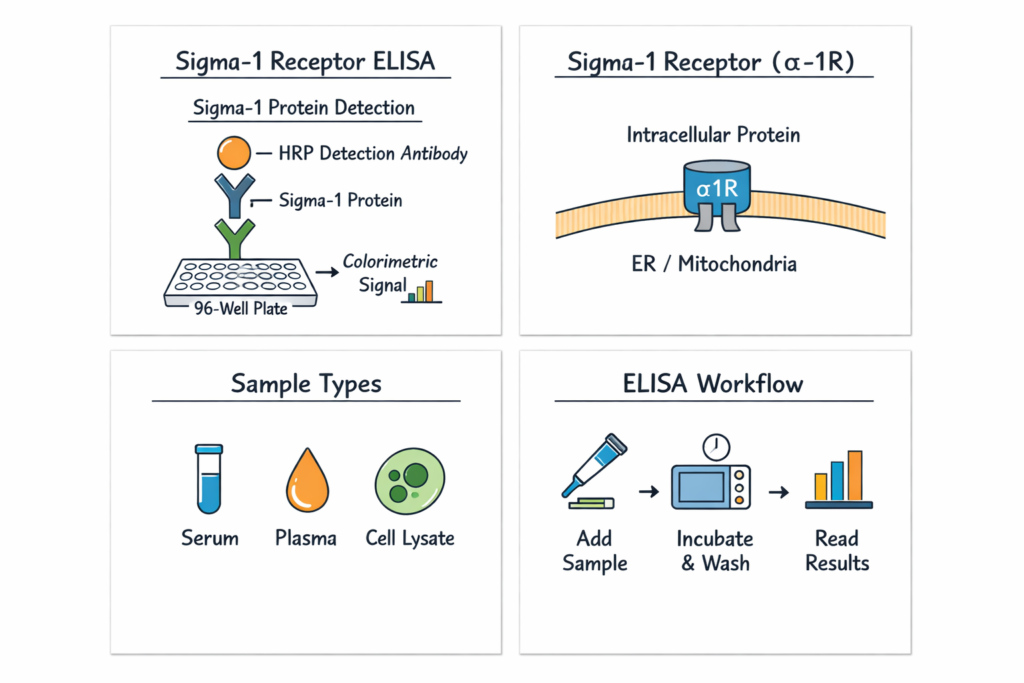
What is Sigma Non-Opioid Intracellular Receptor 1 (SIGMAR1)?
SIGMAR1 encodes the Sigma-1 receptor, a unique intracellular protein originally misclassified as an opioid receptor but later recognized as a distinct molecular entity involved in cellular regulation.
Authoritative biological databases include:
-
NCBI Gene Database (.gov):
https://www.ncbi.nlm.nih.gov/gene/10280 -
National Library of Medicine (.gov):
https://www.nlm.nih.gov -
UniProt Protein Knowledgebase:
https://www.uniprot.org
Genome education resources:
https://www.genome.gov (.gov)
https://www.nigms.nih.gov (.gov)
The Sigma-1 receptor functions primarily as a ligand-regulated chaperone protein influencing protein folding, calcium signaling, and cellular stress responses.
Structural Characteristics of the Sigma-1 Receptor
SIGMAR1 is an integral membrane protein localized mainly in the endoplasmic reticulum (ER), particularly at mitochondria-associated membranes (MAMs).
Structural biology resources:
Educational materials:
https://pdb101.rcsb.org (.edu)
Key structural features include:
-
single transmembrane domain
-
ligand-binding pocket
-
chaperone interaction surfaces
-
dynamic conformational flexibility
These properties allow SIGMAR1 to regulate protein interactions and intracellular signaling environments.
Biological Functions of SIGMAR1
1. Molecular Chaperone Activity
The Sigma-1 receptor stabilizes client proteins and modulates cellular responses to environmental changes.
Educational resources:
https://biology.mit.edu (.edu)
https://medicine.yale.edu (.edu)
https://cellbio.jhmi.edu (.edu)
Chaperone proteins assist in:
-
protein folding regulation
-
stabilization of signaling complexes
-
intracellular protein trafficking
2. Calcium Signaling Regulation
SIGMAR1 plays an important role in regulating calcium exchange between the endoplasmic reticulum and mitochondria.
Learning resources:
https://www.nigms.nih.gov (.gov)
https://www.signalingpathways.org (.gov)
Calcium signaling is essential for:
-
cellular communication
-
metabolic regulation
-
signal transduction pathways
3. Cellular Stress Adaptation Mechanisms
The Sigma-1 receptor contributes to adaptive cellular responses during experimental stress conditions.
Research literature databases:
https://pubmed.ncbi.nlm.nih.gov (.gov)
https://www.ncbi.nlm.nih.gov/pmc (.gov)
Educational materials:
https://hms.harvard.edu (.edu)
![AffiELISA® Chicken Sigma non-opioid intracellular receptor 1 ELISA [ SIGMAR1]](https://affigen.com/cdn/shop/files/5BAFG-E4345_5D_20AffiELISA_C2_AE_20Cattle_20IFNg_20Kit_20High-Resolution_20Interferon_20Gamma_20ELISA_20Detection_83e9b65a-3dd1-4de1-854b-13394e7b8b73_535x.png?v=1712859468)
ELISA Technology Applied to SIGMAR1 Detection
Principle of ELISA
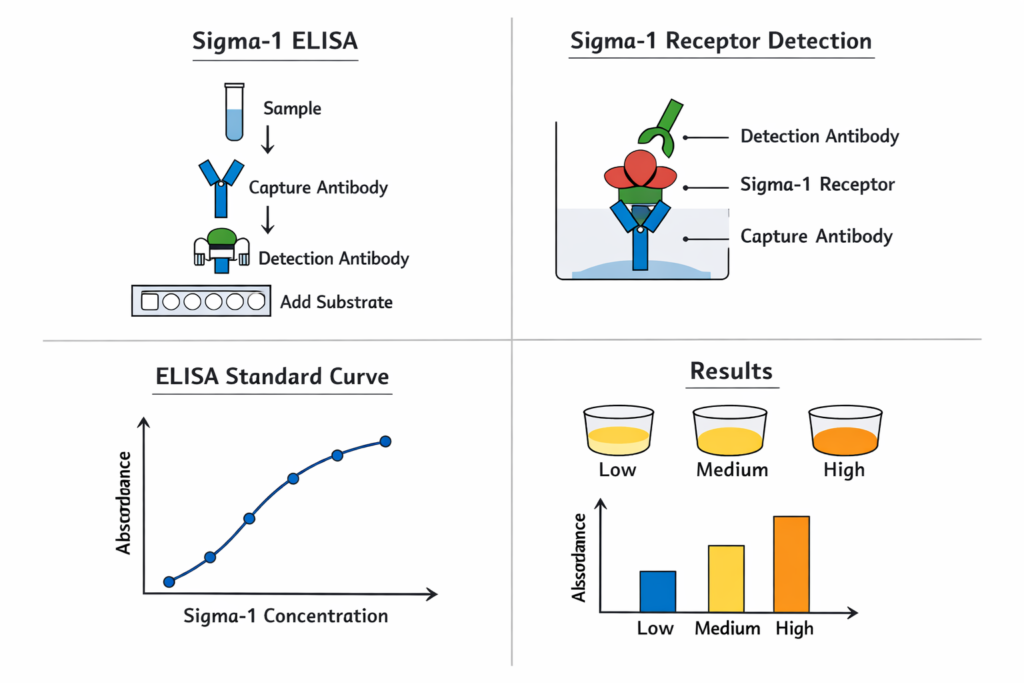
The Enzyme-Linked Immunosorbent Assay detects proteins through antigen-antibody recognition followed by enzymatic signal amplification.
Authoritative explanations:
https://www.fda.gov/science-research (.gov)
https://immunology.arizona.edu (.edu)
Sandwich ELISA Workflow
Typical SIGMAR1 ELISA procedure:
-
Capture antibody immobilization
-
Sample incubation
-
SIGMAR1 antigen binding
-
Detection antibody interaction
-
Enzyme conjugation
-
Chromogenic substrate reaction
-
Optical density measurement
Training references:
https://www.biotech.wisc.edu (.edu)
https://www.purdue.edu (.edu)
Why Measure Sigma-1 Receptor Levels?
Quantitative analysis allows researchers to investigate intracellular regulatory mechanisms under controlled experimental conditions.
Typical research questions:
-
How does SIGMAR1 expression vary between cellular models?
-
How do experimental stimuli influence intracellular receptor levels?
-
How does protein homeostasis change during signaling activation?
Methodology resources:
https://oir.nih.gov (.gov)
Applications of SIGMAR1 ELISA
Intracellular Signaling Studies
https://bioengineering.stanford.edu (.edu)
Protein Homeostasis Research
https://www.washington.edu (.edu)
Organelle Communication Studies
https://med.stanford.edu (.edu)
Systems Biology Integration
https://sysbio.harvard.edu (.edu)
Compatible Sample Types
Commonly analyzed materials include:
-
cell lysates
-
tissue extracts
-
cultured experimental models
-
protein preparations
Sample preparation guidance:
https://www.nature.com/scitable (.edu resource)
Advantages of SIGMAR1 ELISA
✅ High specificity antibody detection
✅ Quantitative reproducibility
✅ Standardized experimental workflow
✅ Microplate reader compatibility
✅ Suitable for large sample numbers
Laboratory standards:
https://www.nist.gov (.gov)
Data Analysis in SIGMAR1 ELISA Experiments
Data interpretation involves:
-
standard curve generation
-
regression modeling
-
concentration interpolation
Statistics education:
https://statistics.stanford.edu (.edu)
Research Trends Involving Sigma-1 Receptor
Scientific interest in SIGMAR1 continues expanding due to its role in intracellular regulation and signaling coordination.
Literature exploration:
https://pubmed.ncbi.nlm.nih.gov (.gov)
Emerging areas include:
-
organelle communication networks
-
molecular chaperone systems
-
cellular adaptation pathways
Integrating SIGMAR1 ELISA into Experimental Workflows
Typical workflow:
-
Experimental treatment design
-
Protein extraction
-
ELISA quantification
-
Data normalization
-
Comparative analysis
NIH training materials:
https://training.nih.gov (.gov)
-
SIGMAR1 ELISA kit
-
Sigma-1 receptor ELISA assay
-
Sigma non-opioid receptor quantification
-
intracellular receptor ELISA
-
SIGMAR1 protein measurement
-
Sigma-1 receptor detection assay
Importance of Standardized Immunoassays
Validated immunoassays ensure reproducibility across laboratories worldwide.
Scientific infrastructure resources:
https://www.nsf.gov (.gov)
https://www.energy.gov/science (.gov)
ELISA remains one of the most widely adopted quantitative protein analysis techniques.
Future Perspectives
As cellular signaling research evolves, quantitative measurement of intracellular regulatory proteins such as SIGMAR1 supports integration with multi-omics and systems biology approaches.
Educational resources:
https://www.caltech.edu (.edu)
https://pme.uchicago.edu (.edu)
Conclusion
The Sigma Non-Opioid Intracellular Receptor 1 (SIGMAR1) ELISA provides researchers with a robust and reliable platform for quantitative analysis of Sigma-1 receptor expression. Supporting investigations into intracellular signaling, protein homeostasis, and organelle communication, this assay enables reproducible experimental insights aligned with modern molecular biology research standards.
Through standardized ELISA methodology combined with high antibody specificity, SIGMAR1 quantification becomes an essential analytical tool for advanced cellular research workflows.