
Introduction
Granulocyte-Macrophage Colony-Stimulating Factor (GM-CSF) is a key hematopoietic cytokine responsible for the proliferation and differentiation of myeloid progenitor cells into granulocytes, macrophages, and dendritic cells. In humans, it is encoded by the CSF2 gene located on chromosome 5q31.1 (ncbi.nlm.nih.gov).
Recombinant Human GM-CSF (rhGM-CSF) has become a critical reagent in immunology, stem cell research, and cell therapy. It is widely used for in vitro culture of myeloid lineages, generation of monocyte-derived dendritic cells (moDCs), and stimulation of progenitor expansion in both primary hematopoietic cultures and cell-line systems such as TF-1 or HL-60.
This article provides a technical overview of GM-CSF molecular biology, protein structure, manufacturing characteristics, bioassay validation, research applications, and SEO-optimized keywords for improved online discoverability.
Molecular Biology of GM-CSF
Gene and transcriptional regulation
The human CSF2 gene is a 2.8 kb segment located on chromosome 5, closely associated with the IL-3 and IL-5 loci (ncbi.nlm.nih.gov). Its transcription is regulated by NF-κB, AP-1, and CREB binding motifs responding to inflammatory signals such as TNF-α, IL-1β, and LPS (pubmed.ncbi.nlm.nih.gov).
Expression occurs in T lymphocytes, macrophages, endothelial cells, fibroblasts, and airway epithelial cells, particularly during immune activation and tissue injury (genome.gov).
Protein structure
GM-CSF is a monomeric glycoprotein (~14–32 kDa depending on glycosylation), consisting of 127 amino acids with two conserved disulfide bonds. The crystal structure shows a four-α-helix bundle typical of class I cytokines (rcsb.org).
Recombinant GM-CSF expressed in E. coli is usually non-glycosylated (~14.6 kDa), while mammalian expression systems (e.g., CHO, HEK293) produce glycosylated variants (~23 kDa). Both retain biological activity through conserved cysteine folding (pnas.org).
Receptor and signalling cascade
The GM-CSF receptor (GM-CSFR) is a heterodimeric complex comprising an α-chain (CD116) and a common β-chain (CD131), the latter shared with IL-3 and IL-5 receptors (ncbi.nlm.nih.gov).
Upon ligand binding, the receptor activates JAK2, leading to phosphorylation of STAT5, MAPK/ERK, and PI3K/AKT pathways. These pathways promote progenitor survival, myeloid differentiation, and immune activation (pubmed.ncbi.nlm.nih.gov).
Expression, Purification and Quality Control of Recombinant GM-CSF
Expression systems
Most recombinant human GM-CSF available for research is expressed in E. coli, yeast (Pichia pastoris), or mammalian systems (CHO or HEK293).
-
E. coli expression yields high purity and activity but lacks glycosylation.
-
Mammalian expression maintains proper folding and glycosylation, improving serum half-life and stability.
-
Yeast expression offers cost efficiency and post-translational modifications similar to mammalian proteins.
Each batch undergoes analytical validation such as SDS-PAGE, mass spectrometry, and RP-HPLC purity assessment (nist.gov).
Purification and refolding
Purification employs ion-exchange chromatography, gel filtration, or affinity tags (His, GST), followed by oxidative refolding to restore disulfide linkages (nih.gov).
Quality attributes
| Parameter | Typical Specification |
|---|---|
| Purity | > 95% by SDS-PAGE |
| Endotoxin level | < 1 EU/µg protein (LAL method) |
| Activity | ED₅₀ = 5–30 pg/mL (TF-1 assay) |
| Formulation | Lyophilized, PBS + carrier |
| Storage | –20 °C / –80 °C long-term |
| Reconstitution | 0.1% BSA + sterile H₂O, aliquot to avoid freeze–thaw |
All these parameters should be verified via lot-specific Certificate of Analysis (CoA) for reproducibility and regulatory compliance (fda.gov).
Bioassay Validation and Functional Testing
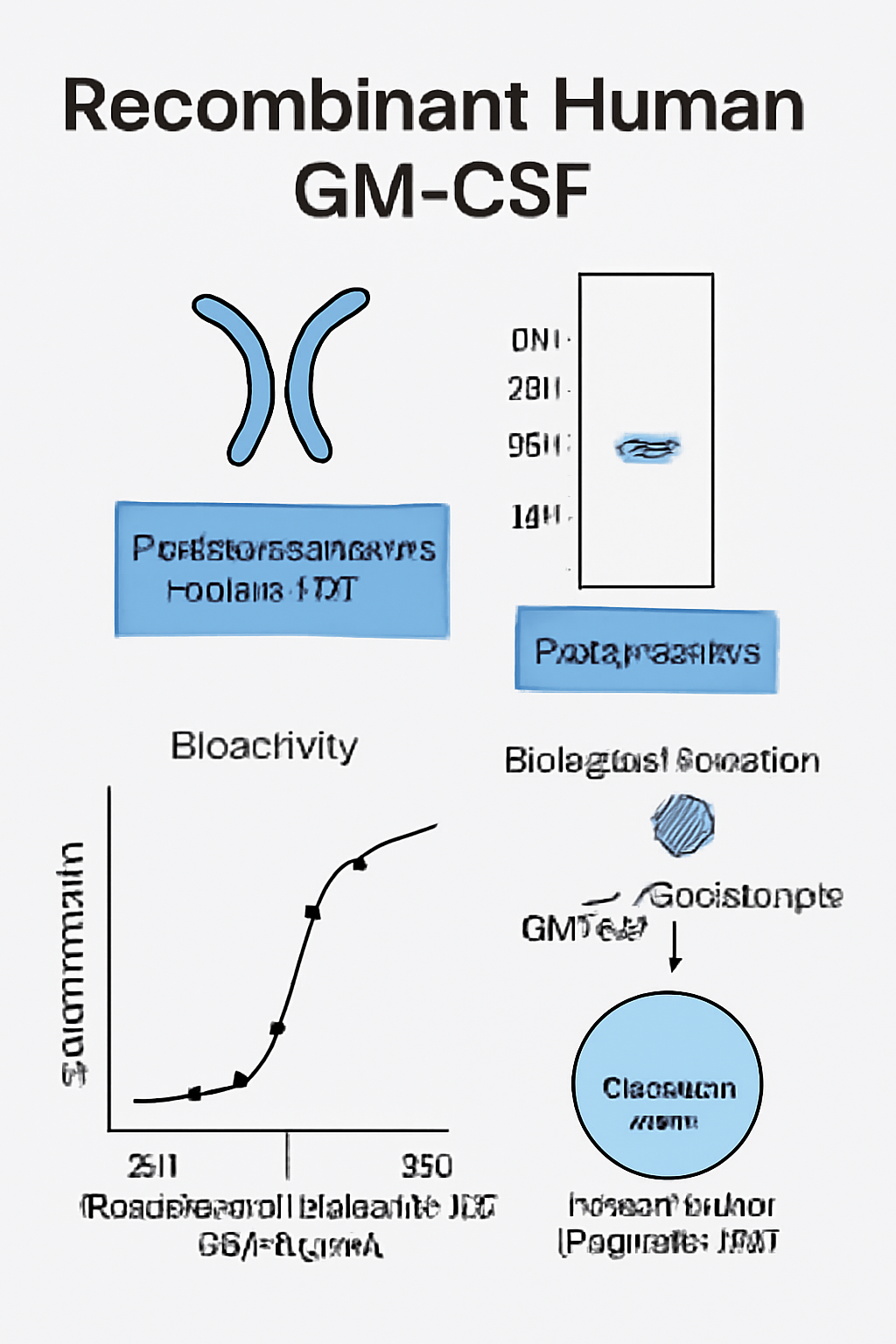
The biological potency of recombinant GM-CSF is validated by cell-based proliferation or differentiation assays, most commonly using the human TF-1 cell line, a GM-CSF-dependent erythroleukemia cell line (atcc.org).
Proliferation assay
-
Assay principle: rhGM-CSF induces TF-1 proliferation proportional to concentration.
-
Readout: colorimetric or luminescent detection of viable cells after 72 h.
-
Reference range: ED₅₀ = 5–30 pg/mL under standard culture conditions.
Differentiation assays
GM-CSF triggers monocyte-to-macrophage or monocyte-to-dendritic-cell differentiation when combined with IL-4 or M-CSF. Cells are phenotyped by CD11c, CD14, HLA-DR, and CD86 expression via flow cytometry (nih.gov).
Cytokine synergy testing
Co-culture studies assess GM-CSF’s synergy with IL-3, IL-5, TNF-α and IFN-γ in modulating myeloid activation and polarization (frontiersin.org).
Recombinant GM-CSF in Research Applications
Hematopoietic stem cell and progenitor culture
rhGM-CSF is indispensable for expanding CD34⁺ HSPCs from cord blood or bone marrow. It supports myeloid progenitor survival and proliferation in combination with SCF and IL-3 (nih.gov).
Monocyte-derived dendritic cell differentiation
The classical method for generating human dendritic cells in vitro employs GM-CSF + IL-4 treatment of peripheral blood monocytes for 5–7 days. The resulting CD11c⁺ HLA-DR⁺ cells exhibit antigen presentation and co-stimulatory capacity (harvard.edu).
Myeloid cell activation and macrophage polarization
GM-CSF biases macrophages toward an M1-like pro-inflammatory phenotype, increasing expression of CD86, IL-12, and TNF-α, contrasting with M-CSF-induced M2-like macrophages (nih.gov).
Cancer and tumour immunology
The CSF2/GM-CSF axis modulates the tumour microenvironment (TME) by recruiting and activating tumour-associated macrophages (TAMs) and dendritic cells. Some cancers secrete GM-CSF to drive immune suppression or angiogenesis (cancer.gov).
Conversely, exogenous GM-CSF is used in cancer vaccines to enhance antigen presentation, as in GVAX (GM-CSF-secreting tumour cell vaccine) trials (clinicaltrials.gov).
Inflammatory and autoimmune disorders
GM-CSF contributes to neuroinflammation, arthritis, and lung alveolar proteinosis. Elevated GM-CSF is associated with multiple sclerosis lesions and rheumatoid arthritis synovial fluid (nih.gov). Recombinant GM-CSF is used as a research tool in modelling these immune processes.
Cell therapy and regenerative medicine
In ex-vivo cell therapy protocols, GM-CSF is applied for myeloid-cell enrichment and monocyte activation before adoptive transfer. It is also used to mobilize progenitors in hematopoietic transplant conditioning (fda.gov).
Handling, Storage, and Technical Best Practices
| Parameter | Recommended practice |
|---|---|
| Reconstitution | Dissolve lyophilized GM-CSF in sterile water + 0.1% BSA to ≥ 10 µg/mL |
| Aliquoting | Divide into small volumes to avoid repeated freeze/thaw |
| Storage | −20 °C (short term), −80 °C (long term); avoid frost-free freezers |
| Sterility | Filter (0.22 µm) before culture addition |
| Working concentration | 10–100 ng/mL typical for monocyte/DC cultures |
| Compatibility | Avoid combination with reducing agents or detergents |
All protocols should reference supplier technical datasheets and follow institutional biosafety guidelines (osha.gov).
Emerging Research Directions
GM-CSF in neuroimmunology
Recent studies show GM-CSF’s role in microglial activation and neuroprotection in spinal cord injury models (nih.gov). Recombinant protein treatments have been shown to promote axonal regeneration and reduce demyelination in experimental settings.
GM-CSF and host defense
GM-CSF enhances alveolar macrophage maturation and pathogen clearance against bacterial and fungal infections such as Listeria monocytogenes and Aspergillus fumigatus (cdc.gov).
Bioengineering applications
Recombinant human GM-CSF is being integrated into microfluidic co-culture systems and 3D organoid models to recreate physiological myeloid niches (nih.gov).
SEO-Optimized Keywords and Metadata Recommendations
For website or catalogue publication, the following keywords and tags should be integrated in meta-title, meta-description, headings, and alt-image text:
Primary Keywords:
-
recombinant human GM-CSF
-
rhGM-CSF protein
-
GM-CSF cytokine human
-
granulocyte-macrophage colony-stimulating factor recombinant
-
myeloid differentiation cytokine
-
dendritic cell generation GM-CSF
Secondary / Long-tail Keywords:
-
CSF2 cytokine human research reagent
-
recombinant GM-CSF for immune cell culture
-
macrophage activation cytokine GM-CSF
-
hematopoietic progenitor expansion factor
-
human GM-CSF ELISA standard
-
GM-CSF receptor signalling pathway
Meta Description (example):
Recombinant Human GM-CSF (CSF2) — active cytokine for myeloid differentiation, dendritic cell generation, and hematopoietic research. > 95% purity, validated in TF-1 bioassay.
Summary
Recombinant Human GM-CSF (CSF2) remains an indispensable cytokine for research and therapeutic development. Its broad biological functions—from stem cell regulation to immune activation—make it a critical reagent for laboratories investigating hematopoiesis, immunology, oncology, and regenerative biology.
A high-quality recombinant GM-CSF should provide:
-
confirmed sequence and bioactivity,
-
purity > 95% (SDS-PAGE validated),
-
low endotoxin (< 1 EU/µg),
-
validated use in cellular assays,
-
comprehensive datasheet documentation,
-
stability under recommended storage.